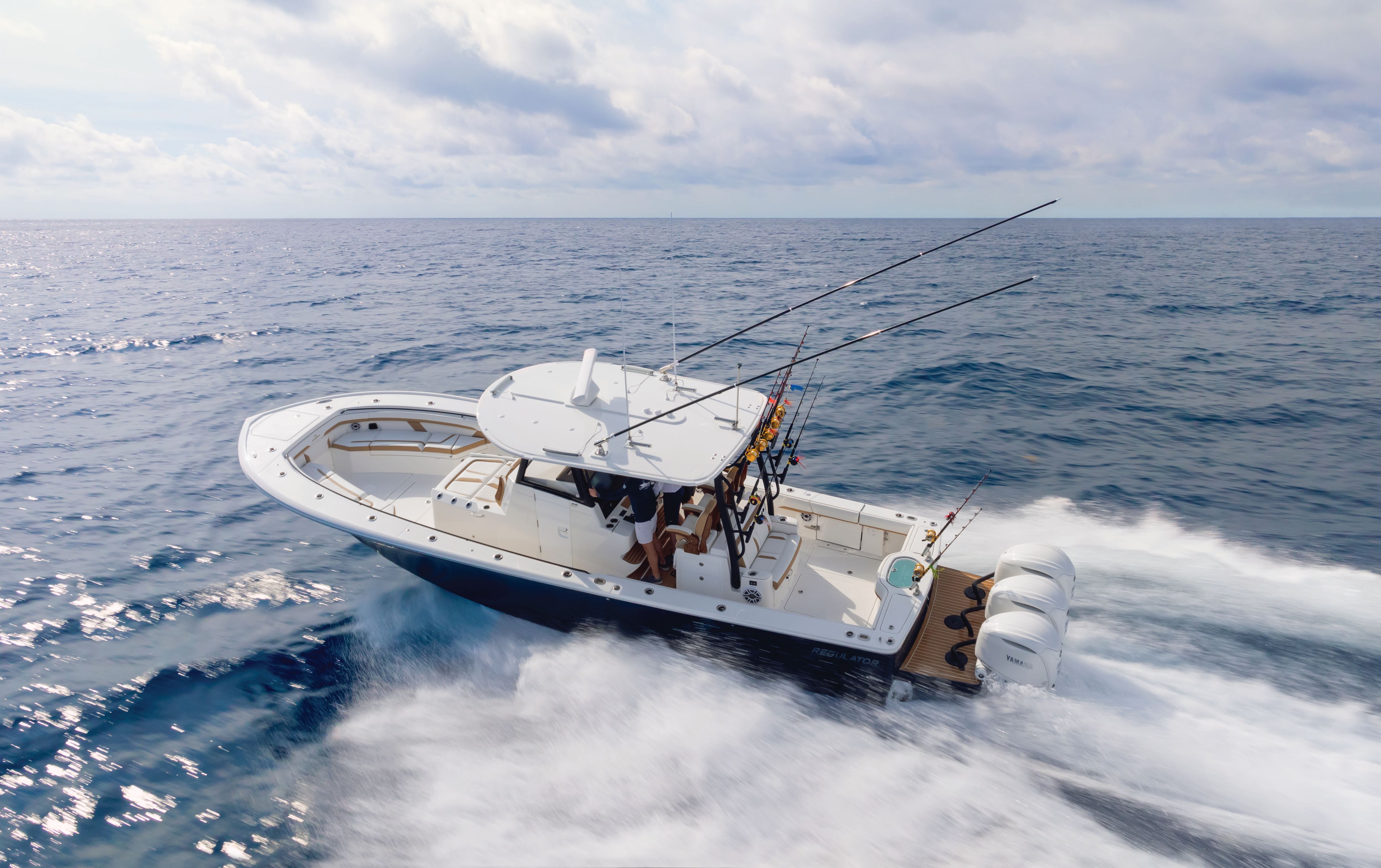
The Regulator 35 is positioned as a premium, offshore-capable 35-foot center-console with meaningful comforts (including a true console cabin) and a heavy emphasis on fishability. Official specs highlight a 35’ 1” LOA, 11’ 9” beam, 405-gallon fuel capacity, 24° deadrise, and a 27”/40” draft (engines up/down).
A key differentiator for the Regulator 35 is how aggressively it integrates “big-boat” systems as part of the standard power-and-ride story: Regulator states triple Yamaha Offshore 350s with HelmMaster™ and Seakeeper Ride 750 ride control are standard. This isn’t just a marketing bullet—Regulator’s published spec sheet and performance bulletin support that this model is engineered around advanced controls, modern onboard power management (including an E-Hub lithium house system), and high-end Garmin electronics packages.
From a performance standpoint, the Yamaha performance bulletin for the triple-F350 configuration reports ~60.9 mph at WOT and highlights an efficient cruise point around 33.7 mph at 1.18 mpg (data is test-condition-dependent). Using that cruise efficiency with a typical 10% fuel reserve yields a theoretical range of roughly 430 miles—strong “go far, come home” math for Gulf and Atlantic runs, while still requiring an honest sea-trial and load-out check for your specific build.
For content marketing and organic search, the opportunity is to publish a “specs + real-world meaning” guide (not just a brochure rewrite), using official numbers and reputable third-party coverage. A detailed review in Marlin underscores the model’s blend of hardcore fishing layout and refined cabin comfort, including sleeping accommodations for two and a stand-up electric head.
Official specifications and performance analysis
Spec snapshot and what it implies
Regulator’s official model page lists the fundamentals buyers search for first—LOA, beam, fuel capacity—and it backs them with a deeper “Quick Stats” block that includes deadrise, draft, tank capacities, and major storage volumes. Key highlights:
- LOA: 35’ 1” (40’ 8” with bracket & engines).
- Beam: 11’ 9”.
- Fuel capacity: 405 gal.
- Dry weight (with engines): 16,500 lbs.
- Deadrise: 24°.
- Draft: 27” engines up / 40” engines down.
Analytically, a 24° deep-V plus 11’ 9” beam suggests Regulator is prioritizing offshore ride quality and stability rather than maximizing interior volume at the expense of seakeeping. The 405-gallon fuel figure is the anchor for offshore planning: it supports long-run logic (especially with modern cruise efficiency), but the real range depends on sea state, prop selection, load, and options.
Power, controls, and stabilization systems
Regulator’s model page explicitly states that triple Yamaha Offshore 350s with HelmMaster™ and Seakeeper Ride 750 ride control come standard. This matters for your messaging because it reframes the boat from “large center console” to “systems-integrated platform”—a shopper comparing 35-footers will often have to add joystick/autopilot/stabilization à la carte on competing builds.
For explaining HelmMaster to shoppers without getting lost in jargon: Yamaha describes Helm Master EX as a joystick/autopilot suite with multiple SetPoint modes and integrated autopilot functionality across multi-engine configurations.
Seakeeper Ride is a different category from a gyro—underway attitude control rather than a flywheel gyro. Seakeeper positions Ride 750 as an underway stabilization system for ~37–42 ft boats (and also describes a 750 Quad variant for transom-fit constraints).
Cabin and “dual-mission” usability
Regulator’s standard equipment/spec sheet describes a console interior/cabin with sleeping accommodations for two and a stand-up electric head (plus storage and rod storage). Third-party reporting emphasizes the same “fish hard, cruise comfortably” blend, describing the interior as spacious with sleeping accommodations for two and a stand-up head.
For your buyer targeting, this is a major conversion lever: you can rank not only for “offshore center console” but also long-tail searches like “center console with cabin” and “35 foot fishing boat with head.”
Performance numbers buyers will ask about
The Yamaha performance bulletin for the Regulator 35CC triple-F350 setup reports:
- Top speed (WOT): ~60.9 mph at 5950 rpm.
- Efficient cruise example: 33.7 mph at 3500 rpm, 28.7 gph, ~1.18 mpg.
A practical way to communicate “range potential” without overpromising is to show the math as an estimate: at ~1.18 mpg and keeping a 10% reserve, the theoretical range is about 430 miles (405 gal × 0.9 × 1.18).
Regulator 35 Center Console: Specs, Performance, and Offshore Capability
Why the Regulator 35 stands out in the 35-foot class
A 35-foot center console is a “do-everything” size class—big enough to run offshore with confidence, but still agile for sandbar days and family cruising. The challenge is that many boats in this category lean hard either toward fish-first simplicity or toward luxury-first complexity.
The Regulator 35 aims to remove that tradeoff by building a true offshore fishing platform around modern, integrated systems and a legitimately usable console cabin. Regulator’s own positioning calls it “a new icon,” emphasizing high-tech systems, serious fishability, and flexible seating layouts designed to satisfy anglers and boaters who want one boat that does it all.
Regulator 35 specs that matter to buyers
The quickest way to understand how a boat will behave offshore is to stop scanning marketing adjectives and look at hull and capacity fundamentals.
Start with size and stability. The Regulator 35 is 35’ 1” LOA with an 11’ 9” beam—wide enough to provide confident at-rest stability for drift fishing and sandbar hangouts, while still staying within a performance-oriented offshore profile.
Next is the offshore “ride signal”: a 24° deadrise. In plain English, that’s a deep-V design intended to soften impact and maintain composure when conditions get sporty. If your buying journey includes long Gulf runs, crossing inlet slop, or pushing home as the weather changes, this number is not trivia—it’s a core part of the value proposition.
Fuel and tankage is where the 35 separates itself as “go-far capable.” Regulator lists a 405-gallon fuel capacity, paired with a 36-gallon freshwater tank and a 12-gallon holding tank. That combination supports long days offshore, plus the onboard comfort most families expect at this size.
Draft is the last spec that changes your day-to-day reality. The Regulator 35 lists 27” draft with engines up and 40” with engines down. That’s shallow enough for many nearshore and sandbar environments when trimmed up, but still deep enough (down) that you’ll want to stay disciplined approaching skinny water with the engines lowered.
Performance with triple Yamaha 350s
Buyers love top speed, but what matters more is the speed-and-efficiency band where you’ll actually run most of the time.
Regulator states that triple Yamaha Offshore 350s with HelmMaster and Seakeeper Ride 750 come standard, framing the boat as a factory-integrated performance and control package rather than a “pick your system upgrades later” build.
On published test data, the Yamaha performance bulletin for the triple-F350 setup reports about 60.9 mph at wide-open throttle. More interesting for most owners is a cruise reference point: 33.7 mph at 3500 rpm, 28.7 gph, and about 1.18 mpg.
If you translate that cruise mpg into “how far could I go,” a simple planning estimate (using a 10% reserve) suggests roughly 430 miles of theoretical range. Real-world range will vary with sea state, load, bottom condition, and options—so the right move is to validate performance on the exact boat configuration you’re buying.
Fishing layout and on-deck function
The Regulator 35 is designed as a fishing boat first, and it shows in the storage volumes, bait workflow, and deck planning.
Regulator highlights in-deck fishboxes, an “oval pressurized center livewell,” and up to 49 rod holders—signals that the build intent is offshore angling, not just “fishing-capable cruising.” Official quick stats list multiple insulated fishbox and cooler capacities, including a forward in-deck fishbox (210 qts), dual forward seat fishbox/dry storage (211 qts each), aft in-deck fishboxes (161 qts each), and a 43-gallon transom livewell.
For serious anglers, what matters is not just “it has fishboxes,” but whether the workflow is clean: bait station placement, maceration/pump-out, and whether you can fish without turning the cockpit into chaos. Regulator’s published standard equipment calls out dedicated bait prep stations, a pressurized livewell with high-volume pump, multiple macerated fishboxes, and a raw-water sea chest concept—details that support the story of a boat meant to be used hard.
Comfort and cabin features for long days
At 35 feet, comfort isn’t a luxury—it’s fatigue management. It’s also what expands the buyer pool from “hardcore anglers only” to families and mixed-use owners.
Independent review coverage describes the console interior as surprisingly spacious, with sleeping accommodations for two and a stand-up electric head—making overnights and all-day trips far more practical. Regulator’s own standard equipment sheet aligns with that, describing sleeping accommodations for two plus a stand-up electric head with countertop and sink, and multiple storage compartments.
On deck, seating versatility is another “wide-audience” feature. Regulator describes standard split forward seating with an optional wraparound configuration—useful because anglers often prefer an open bow workflow, while families often want lounge-style seating at rest.
Technology stack: helm, power, and connected systems
High-end center consoles increasingly compete on systems integration, not just hull geometry.
Regulator’s “Offshore Command Center” language emphasizes flush-mounted Garmin multifunction displays, Yamaha digital boat control, Fusion stereo, and a Regulator MyHelm interface for system management and connectivity. The standard equipment spec sheet further details a factory-installed Garmin package including two 22” GPSMAP displays, radar, and transducer hardware—exactly the kind of “ready now” electronics story buyers want in this segment.
Power management is another differentiator. Regulator specifies an E-Hub lithium house battery system as part of the standard equipment, positioned as seamlessly managed via MyHelm.
Stabilization is where the “comfort + fishability” narrative becomes measurable. The model page points to a Dometic DG3 gyro feature; Regulator’s spec sheet lists gyro options/gyro-ready configurations, while a Regulator blog post details DG3 spin-up claims and integration on the Regulator 35. For broader context, Dometic positions DG3 as a gyro with industry-leading spin-up/down times and a stated 40% reduction in power consumption, with multi-voltage compatibility.
Buyer checklist, sea trial tips, and next steps
A 35-foot offshore center console is a major purchase—your content should guide buyers to make a confident decision, not just generate leads.
A strong sea trial plan includes: running at multiple RPM bands (idle, displacement, midrange cruise, faster cruise, and a brief WOT), evaluating spray and dryness, testing joystick docking behavior, confirming helm visibility and ergonomics, and checking that fishbox/livewell access makes sense for how you fish. Independent sea-trial commentary on the Regulator 35 emphasizes ride stability, dryness, and the fishing-forward layout while still delivering comfort features below the console.
Finally, be transparent that model-year specs and options can vary. Regulator explicitly notes that model year specifications may vary—so your page should encourage buyers to confirm the exact build sheet for any unit they’re considering.